The useful question is not simply whether a property is “an HMO”. It is who occupies it, how many households they form, what facilities they share, whether a local designation applies and whether the physical use has the necessary planning and building-control position.
What Slough is proposing.
Slough Borough Council launched a ten-week consultation on 15 July 2026 on two proposed property-licensing schemes. The consultation closes on 23 September 2026 and covers every ward in the borough.
The proposed additional licensing scheme would bring smaller HMOs into licensing where three or four people from two or more households share facilities such as a kitchen or bathroom. It would also cover certain converted buildings containing self-contained flats which fall within section 257 of the Housing Act 2004.
The proposed selective licensing scheme would apply more widely to privately rented homes occupied by a single family, a single person or up to two unrelated sharers, unless another licensing regime applies.
The council says the schemes together could cover almost 17,000 private rented properties. Its evidence predicts 2,024 HMOs in Slough and estimates that 22.3% have a serious housing hazard. Those figures and the proposed licence conditions, fees and operation are matters on which landlords, tenants and other interested parties can still comment.
Consultation is not designation. As at 5 September 2026, Slough’s proposed new borough-wide selective and additional schemes have not yet been finally agreed or brought into force.
What applies in Slough today?
Slough’s former borough-wide additional licensing scheme and its selective licensing scheme for Chalvey and Slough Central ended on 30 June 2024. An unexpired licence granted under either former scheme continues until it expires or is revoked, but the old designation does not create a present obligation to make a new application.
Mandatory HMO licensing continues independently. In broad terms, it applies where five or more people forming two or more households occupy an HMO, subject to the statutory definition and exemptions. Other housing-management, safety, planning and building-control obligations also continue whether or not a discretionary licensing scheme is in force.
If the council decides to proceed after consultation, it must publish the final designation, area, commencement date, conditions and application arrangements. Landlords should act from those final documents rather than assuming the consultation proposals are already law.
Why a garden outbuilding is not only a licensing question.
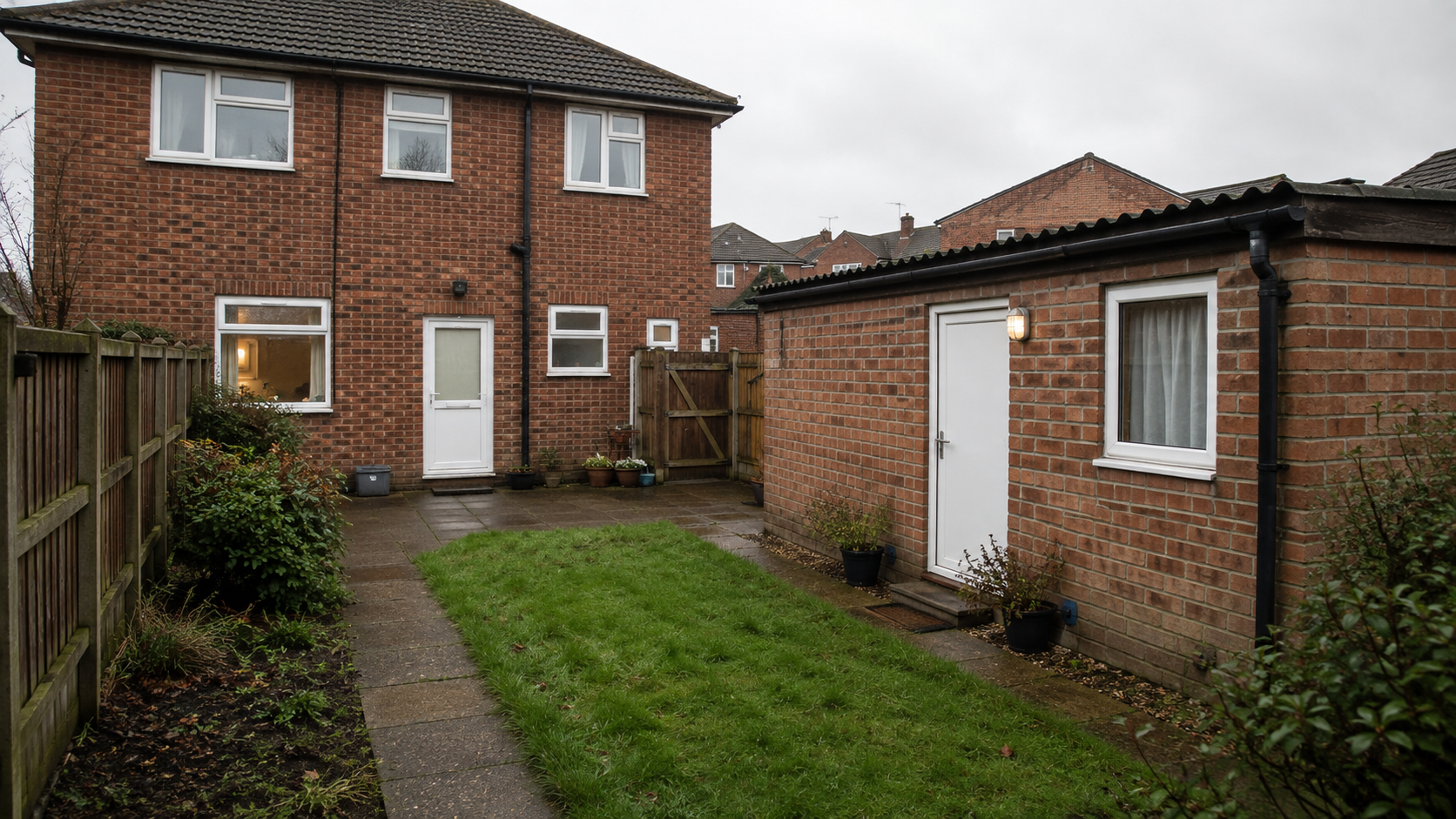
A converted garage, cabin or garden room may be physically capable of occupation without being lawful or safe residential accommodation. Depending on its construction and use, the position can involve:
- planning control—including a material change of use, operational development or an existing enforcement notice;
- building regulations and fire safety—including structure, insulation, escape, alarms and separation;
- housing standards—including space, amenities, damp, heating and hazards;
- HMO or selective licensing—depending on the occupiers, households, shared facilities and any local designation; and
- tenancy and management records—which may reveal how the accommodation is actually let and used.
Slough’s own outbuildings guidance warns that planning permission or building-regulations approval may be required and that self-contained accommodation may also need a rental licence. The key word is also: a licence application does not grant planning permission, and planning status alone does not answer the licensing question.
The Slough “bed in shed” court case.
A local case illustrates how the regimes can meet. Slough Borough Council reported in October 2021 that Paul Vig had admitted failing to comply with a planning enforcement notice prohibiting a garden outbuilding at Reddington Drive, Langley, from being used as a self-contained residence.
The council said the structure contained washing and cooking facilities and had been let for £160 per week. A 2015 enforcement notice had required the residential use to stop. The continued use was later identified when an application was made for a compulsory HMO licence for the property.
At a Proceeds of Crime Act hearing in Reading Crown Court, Mr Vig was fined £5,000 and ordered to pay £8,161.67 towards the council’s costs. Maria Vig received a six-month conditional discharge and was ordered to pay £4,000 costs. The judge treated the duration, financial gain, poor amenity and impact on the tenants as aggravating features.
This was a prosecution for breach of a planning enforcement notice—not simply a prosecution for failing to hold an HMO licence. That distinction is important. The HMO application brought the occupation to the council’s attention, but it did not regularise the prohibited outbuilding use.
The wider exposure for an unlicensed property.
Where a property is required to be licensed under mandatory, additional or selective licensing and no valid application or exemption is in place, the consequences can extend beyond the licence fee. They may include prosecution or a civil financial penalty, licensing or management action and an application for a rent repayment order.
For qualifying offences committed on or after 1 May 2026, current government guidance says a tribunal can order repayment of up to two years’ rent. Earlier offences are subject to transitional rules, including the previous one-year maximum. The amount and liability are fact-specific, and a landlord may rely on a statutory defence such as reasonable excuse where the evidence supports it.
The commercial lesson is straightforward: do not rely on an old licence, a historic council scheme, an agent’s assumption or the property’s physical appearance. Confirm the present occupation and the current designation.
A practical landlord audit before the scheme is decided.
- Map the occupiers. Record every person, household relationship, tenancy or licence and the facilities they share.
- Map the accommodation. Identify every bedroom, flat, converted garage and outbuilding, including any independent cooking or washing facilities.
- Check the existing licence. Confirm the licence type, named licence holder, conditions and expiry date rather than assuming it transfers or renews automatically.
- Check planning history. Obtain permissions, approved plans, lawful-development certificates and any enforcement or warning notices.
- Check safety evidence. Review the fire-risk position, alarms, electrical and gas records, room sizes and material housing hazards with suitably qualified specialists where required.
- Track the Slough decision. Note the consultation deadline and review the final Cabinet decision and designation before any commencement date.
For a portfolio, use a property-by-property schedule. A licence is normally specific to the property and licence holder, while the correct regime can change when occupation or local designations change.
A useful initial review should identify the current licensing position, any planning or physical-use conflict, the evidence missing from the file and the actions that need to be completed before a council deadline or inspection.
This insight provides general information about property licensing and planning control in England. Slough’s proposed schemes are under consultation at the publication date and may change or not proceed. Licensing requirements, definitions, exemptions, transitional rules and enforcement consequences depend on the property, occupation, dates and final designation. This is not legal, fire-safety, building-control or planning advice for a particular property.